

Metal crushed by Jaw crusher is flaky and have more corners. Out put
of V.S.I. crusher is Cubical. Cubical material is having less surface area
compared to flaky material. Flaky material have approximately 16% more
area then the cubical material for the same volume/ weight of the particles.
For Asphalting or Page3 In cement concrete, the overall surface of the metal
required. So again more surface area, so more consumption of Cement or Asphalt.
Or in other words we can say the strength of the concrete increases for the same
cement/ asphalt consumption.
This can be proved with the help of following example. Flaky material means
chip of the stone having more length and width compared to thickness. Let us take
a piece of stone having length 2 units X 1unit X 0.5 unit So the Volume of this
particle will be 2 X 1 X 0.5 = 1 cu unit. At the same time the surface area of this
particle will be 7 sq. unit. ( 2 X 2 X 1 + 2 X 2 X 0.5 + 2 X 1 X 0.5 = 7 sq unit.)
For the Same volume if we select a cubical particle it's length breath and height
will be 1 Unit. So the Volume comes to 1 X 1 X 1 = 1 Cu unit. And surface area is
1 X 1 X 6 = 6 Sq. Units.
Thus for the same volume the surface area of the particle is increased by 16%
approximately. Crushed metal from Jaw crusher is generally flaky, and from V.S.I.
Crusher is cubicle. There fore there is 10 to 15% more strength for the same cement
or asphalt Consumption. There is also a problem with flaky material while rolling it
gets break and the broken surface do not have any coating of asphalt, makes the
section weak. Hence more life of the road can be achieved by using the cubicle metal.
Again less voids in the cubical metal so more dense concrete, so more strength.
For Crushing 6,000 cft (aprox. 250 tons) of 20 mm metal per day requires minimum
for crushers of 20X12 or 24X10 size. The unwanted material produced is about 65% .
Total H.P. required to run four crushers is about 120
H.P. ( Excluding Conveyors and Grading Screen etc) ×
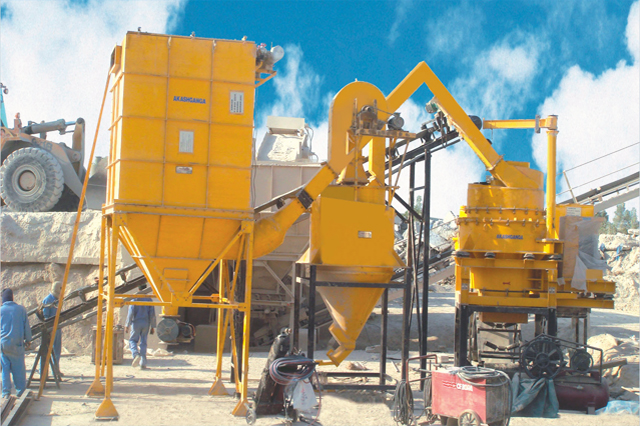
Above can be replaced by One Jaw Crusher and One VSI crusher, So the total H.P.
required is only 90. It can give same production, and unwanted material is reduced
to 40%. If in addition to this unit a Rotopactor is installed, which can convert unwanted
material to sand. It will require 40 H.P. Thus total H.P. will be 130 H.P.
Total cost of this set is same, but the raw material cost is reduced by 40% (due
to unwanted material not produced). And as all material produced is have immediate
demand, the profit increases by 40%. The storing cost and selling at low rate is avoided,
and with no environmental impact. The cost of production is also reduced to a substantial
(wearing of Jaws and other parts of Crusher).
• Less power consumption per ton of Crushing.
• Very simple mechanism, so can be operated by any unskilled worker.
• Final crushing can be adjusted by changing the speed of the machine. Any gradation
can be achieved. Perfect control of output size can be achieved.
• reduction of finer product ( unwanted )
• Suitable for any type of stone.
• More cubical crushing compared to any other machine.
• In our machine if trap iron enters the machine, there is no harm. It will not break
any part.
• Very less wear cost compared to any other machine.
• Bearings are forced oil lubricated, so least failure of bearings. Heat generated while
in operation is taken out by oil. So no rise of bearing temperature
• Due to special design of rotor and anvil bigger material can be fed to the machine.
And crushing is with less power.
• In our Rotopactor ( specially designed for making sand ) with closed rotor, feed
up to 20 mm can be accepted. Means it can easily crush 12 mm material with
less power supply.